
Your archetype

    The Mediator

    I build bridges where others see a wall.

    The Mediator in you

    The Mediator in you is harmony, diplomacy and balance. You see what's legitimate on both sides even when they clash, and that lets you do something rare: build bridges and help opposing parts find balance. You lower the temperature of a conversation without emptying it of content, and translate each position so the other can actually hear it. Where there was deadlock, with you a common space appears.

    Its reverse is the same gift taken too far. When harmony becomes the absolute priority, you can avoid conflict or keep the peace at the cost of truth: staying quiet about your own view, softening what needed to be said plainly, upholding an agreement that isn't really one. The medicine is letting harmony include honest differentiation: naming a difference doesn't break the bridge, it's what makes it strong.
    How does the Mediator show up in each of the five disciplines?

    In your birth chart. This is where the Mediator shows up most clearly. Venus, the planet of bonding and of what draws us in, and the seventh house, that of one-to-one relationships, weigh the same. Behind them comes the Descendant, the exact point of meeting the other, and the water element and being born on a Full Moon add up. Libra is its sign.

    In your BaZi. This archetype has an honest quirk: it's the one with the fewest signals in the Chinese reading. Only the Rabbit activates it, the animal associated with diplomacy and with avoiding direct confrontation. No element and no Ten God mark it. That isn't a gap in the system: it means the Mediator is recognised above all by how you relate, not by your baseline energetic configuration.

    In your Human Design. Its strongest signal is Emotional Authority, the one that needs time before deciding because it knows it can't see clearly in the heat of the moment. Behind it come the absence of inner authority — deciding through conversation — the Projector type and line 4 of the profile, that of the trusted network. The G centre adds up too.

    In your palmistry. It doesn't calculate the archetype. In a Mediator it usually adds information about how your bonds have taken shape and in which stages you had to be the bridge between others.

    In your graphology. Your signature doesn't decide that you're a Mediator. It adds the nuance of how much you assert yourself when writing your own name, which in this profile tends to be the most direct indicator of whether the harmony includes you.

    What are the Mediator's blind spots?

    Avoiding conflict. It's its shadow exactly as the system names it. Putting off a hard conversation doesn't defuse it: it lets it grow, and when it finally arrives it's bigger.

    Keeping the peace at the cost of the truth. This archetype's central blind spot. Harmony held up by swallowing what you think isn't harmony: it's a truce somebody is paying for, and usually it's them.

    Disappearing into the neutral position. From understanding every side so well, the Mediator sometimes forgets which one was theirs. It can go on for years without anyone noticing, starting with themselves.

    The medicine is letting harmony include honest differentiation.

    Which other archetypes does the Mediator fit best with?

    Ovinchi's system points to two that balance it: the Warrior and the Leader.

    The Warrior is the direct antidote: it reminds the Mediator that some conflicts are only resolved by walking into them, and that saying no is also a form of care.

    The Leader brings the decision. Where the Mediator would keep listening to positions, the Leader closes, and that combination keeps the search for balance from turning into paralysis.

    Beyond what the system calculates, the most common friction is with the Alchemist: one believes some conversations aren't worth it, the other that whatever goes unnamed rots.

    Frequently asked questions — Mediator

    What is the Mediator archetype?
    The Mediator is the personality pattern that builds bridges. It listens to each side, senses what each one needs and looks for the point where everyone can stand. Its strength is turning opposing positions into something you can actually talk about.
    How do I know if my dominant archetype is the Mediator?
    It's usually recognised by whoever ends up translating between two people arguing, physically feels other people's tension, and discovers on reviewing their decisions that many were made thinking more about the effect on others than about what they wanted.
    How is the Mediator different from the Healer?
    The Mediator balances between several; the Healer accompanies one. One stands in the middle of a conflict, the other beside whoever is struggling. The first looks for agreement, the second for relief.
    Why does the Mediator have so few signals in BaZi?
    Because in Ovinchi's system this archetype is detected above all through the relational configuration of the birth chart and through the way of deciding in Human Design. In the Chinese reading only the Rabbit activates it, which shows it's a pattern expressed in the bond rather than in baseline energy.

    This is an approximation. Your Holistic Self is something else.

    Eight questions give you a snapshot. Your Holistic Self is calculated by cross-referencing your five charts — birth chart, BaZi, Human Design, palmistry and graphology — turning them into a map of who you are that doesn't depend on how you feel today.

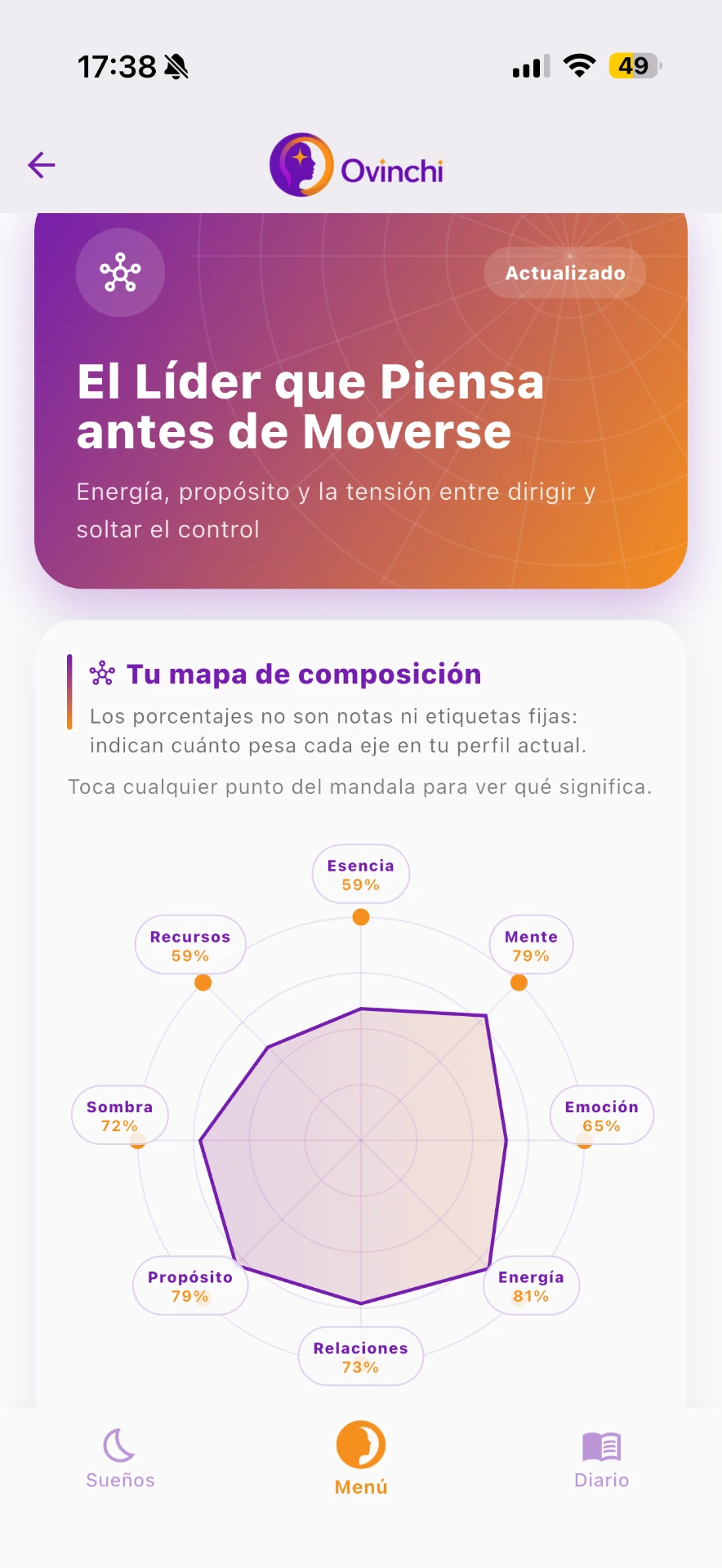
    Eight axes, not a label

    • Essencewho you are underneath it all
    • Mindhow you think and decide
    • Emotionhow you feel and regulate yourself
    • Energyhow your force moves
    • Relationshipshow you bond
    • Purposewhere you push toward
    • Shadowwhat you repeat without seeing it
    • Medicinewhat brings you back to balance
    • All twelve archetypes with their exact proportion in you, not just the strongest one
    • Your personal shadow and medicine, calculated, not generic
    • A complete PDF report to keep or share
    My Holistic Self screen in the Ovinchi app: the twelve archetypes with their proportion and the eight personal axes

    You already know your dominant archetype. What's missing is knowing in what proportion the other eleven make you up.