
Palmistry: what palm reading is and how to interpret it with judgment
A clear, complete guide to understanding palmistry, its main elements, and its value as a symbolic tool for personal observation.
In short
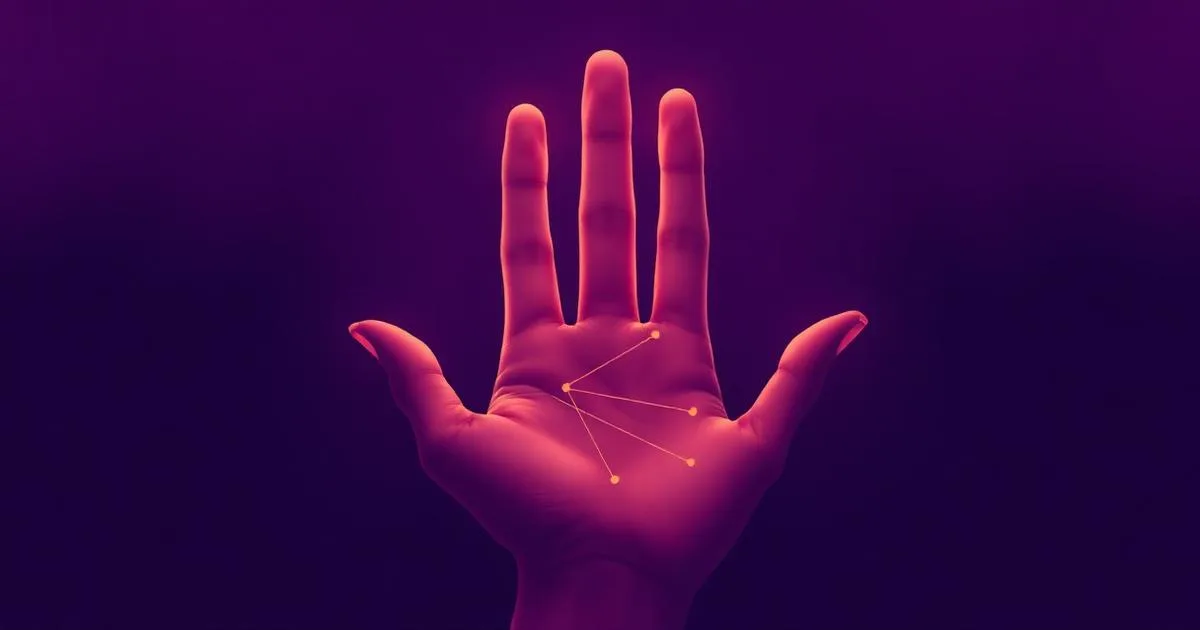
Palmistry, also known as palm reading, is an ancient symbolic discipline that interprets the palm, the fingers, and the shapes and contours of the hand to explore personality traits, ways of feeling, ways of thinking and certain life tendencies.
The main lines — life, head, heart — and the mounts, the fleshy areas associated with drives or qualities, are the most closely observed elements. A serious reading does not stop at one isolated line: it takes in the overall context of the hand, the difference between the dominant and non-dominant hand, and the ethics of how it is interpreted.
Used with judgment, palmistry can be an interesting tool for self-knowledge and reflection. It is not an exact science and it does not replace professional advice. Its value lies in its capacity to open up useful questions about yourself.
Where does palmistry come from?
Palmistry has very old roots. Its earliest developments are usually placed in India, within traditions that read the body as a reflection of character and destiny. From there its study spread to other regions: China, Persia, Egypt and Greece. Later it passed through cycles of popularity, decline and reinterpretation in Europe.
In the classical tradition, the hand came to be read as a space charged with meaning. Over time the practice was enriched with planetary symbols, mythological associations and observations about human temperament. In the nineteenth and twentieth centuries palmistry found new momentum in the West through interest in esoteric disciplines and in symbolic systems applied to self-knowledge.
What does palmistry actually look at?
Broadly, a palm reading tends to consider:
- The overall shape of the hand
- The length and proportion of the fingers
- Texture and flexibility
- The main and secondary lines
- The mounts, or raised areas of the palm
- The difference between one hand and the other
The aim is not a closed prediction, but the interpretation of patterns and tendencies.
The main components: lines and mounts of the hand
Classical palmistry rests on two broad groups of elements: the lines and the mounts.
The main lines
The life line
It curves around the base of the thumb. It is usually associated with vitality, resilience and how a person manages their energy. It should not be read as a literal counter of years: for observing life stages, the birth chart and its planetary cycles are far more reliable.
The head line
It runs horizontally across the center of the palm. It relates to the mind, to thinking style and to how decisions are processed. A straighter line tends to be linked with the practical; a more curved one with imagination and intuition.
The heart line
The upper horizontal line, sitting below the fingers. It speaks of the emotional world, of how someone bonds, and of how affection is expressed.
The fate line
It usually runs vertically towards the center of the palm. It is associated with life direction, vocation, and the influence of external factors on a person's path.
The sun line, or line of Apollo
Normally found below the ring finger. It is linked to creativity, recognition, personal fulfillment and the expression of talent.
The health line, or line of Mercury
It is not always present. Some schools associate it with nervous energy, physical sensitivity or the relationship between body and mind. Its interpretation varies considerably between traditions.
The main mounts
Mount of Venus
At the base of the thumb. It relates to vitality, desire, affection and the capacity to enjoy life.
Mount of Jupiter
Below the index finger. Linked to ambition, leadership, self-esteem and the drive to grow.
Mount of Saturn
Below the middle finger. Associated with responsibility, discipline, seriousness and depth.
Mount of Apollo, or of the Sun
Below the ring finger. It speaks of creativity, charisma, artistic sensitivity and a desire to express.
Mount of Mercury
Below the little finger. Related to communication, curiosity, social skill and quickness of mind.
Mounts of Mars
Usually divided into two zones. They are associated with courage, endurance, self-defense and how someone responds to pressure.
Mount of the Moon
On the outer lower area of the palm. Linked to imagination, intuition, the deeper emotional world and sensitivity.
Lines and mounts compared
| Element | Location | Brief meaning |
|---|---|---|
| Life line | Arc around the thumb | Vitality, resilience, how energy is managed |
| Head line | Horizontal, across the center of the palm | Thinking, mental focus, reasoning |
| Heart line | Upper horizontal line, below the fingers | Emotional life, bonds, how affection is expressed |
| Fate line | Vertical, through the center of the palm | Life direction, vocation, influence of surroundings |
| Sun line | Vertical, below the ring finger | Creativity, fulfillment, recognition |
| Health line | Towards the little finger | Physical or nervous sensitivity, depending on the school |
| Mount of Venus | Base of the thumb | Passion, vitality, affection |
| Mount of Jupiter | Below the index finger | Leadership, ambition, confidence |
| Mount of Saturn | Below the middle finger | Discipline, realism, responsibility |
| Mount of Apollo | Below the ring finger | Creativity, personal shine, charisma |
| Mount of Mercury | Below the little finger | Communication, wit, curiosity |
| Mounts of Mars | Edges of the palm | Courage, defense, response to conflict |
| Mount of the Moon | Outer lower edge | Intuition, imagination, sensitivity |
Schools and cultural differences: the West, India and China
Although palmistry shares a common base, it is not practiced in exactly the same way everywhere.
Western palmistry
In the West, readings tend to give considerable weight to the main lines and the mounts. It is also common to distinguish between dominant and non-dominant hand, taking the former as the person's current or developed expression.
The Indian tradition
The Indian tradition tends to read both hands in greater depth. It usually treats one as a reflection of original potential and the other as a reflection of how life has actually unfolded. It also integrates the shape of the fingers, the nails and other physical details more readily.
The Chinese approach
Chinese palm reading is usually connected to a broader view of energetic balance. In some approaches the palm is not interpreted alone but alongside other elements of the face or body. The central idea is to observe how personal energy is expressing itself.
How is a palm reading done?
A good reading calls for observation, care and context.
1. Choose which hand to look at
In many schools the dominant hand reflects how a person expresses themselves today, and the non-dominant one their base or potential. Comparing them can enrich the interpretation considerably.
2. Set up good conditions
The hand must be clearly visible. Ideally: good light, a relaxed palm, clean dry skin, fingers visible without tension and, if the reading is done remotely, a sharp photograph. A poor image leads to poor or confused interpretations.
3. Look at the whole before the detail
Before going into the lines, it is worth looking at the overall shape of the hand, the length of the fingers, flexibility, texture and the balance between areas. A serious reading does not start with a single isolated line.
4. Interpret with care
Palmistry works best used as a symbolic language rather than a verdict, and it gains meaning when read alongside other readings inside a unified interpretation of the five disciplines. A good reading guides; it does not frighten.
5. Mind the ethics
Palm reading touches on intimate ground, just as graphology and signature analysis do. It matters to ask for consent, respect privacy, avoid absolute claims, never use fear as a tool, and never replace professional help with a symbolic interpretation.
What to understand before reading a hand
Palmistry is not looking for verdicts: it is looking for patterns. A serious reading takes in the whole context — shape, lines, mounts, texture, the comparison between hands — and interprets it with respect, care and no absolute promises. The value is in the questions it opens, not the certainties it closes.
Three simplified worked examples
These examples are indicative and simplified. They illustrate the logic of a reading; they are not a closed template.
Illustrative example
A creative hand oriented towards growth
What is observed: A deep life line, a curved head line, a strongly marked heart line, a raised mount of Jupiter and a visible fate line.
Interpretation: This combination tends to be associated with someone vital, imaginative, healthily ambitious, and building a path with purpose. There is a mix of emotional energy and a desire to move forward.
A question to sit with: Am I channelling my creativity into something concrete, or letting it scatter?
Illustrative example
An analytical, reserved hand
What is observed: A straight, deep head line, a straighter heart line, a marked mount of Saturn, a finer life line.
Interpretation: Here a reflective, cautious, serious and very mental profile tends to appear. There may be emotional restraint, or a more rational way of relating to what is felt. It can also point to a need to look after one's energy better.
A question to sit with: Am I thinking things over so much that I struggle to say what I actually feel?
Illustrative example
An intuitive, changeable hand
What is observed: A life line with breaks and shifts, a faint fate line, well-developed mounts of Venus and the Moon, a present sun line.
Interpretation: This pattern is usually linked to people who are sensitive, intuitive, creative and not especially linear. There is emotional strength and a capacity to reinvent, though there may also be periods of doubt or significant inner change.
A question to sit with: Do I trust my intuition when I have to decide, or do I only listen to it once it is too late?
How to use palmistry for self-knowledge
Palmistry is most useful when approached as a tool for personal observation. Instead of asking "what is going to happen", it tends to be more valuable to ask:
- How am I managing my energy?
- Where do I make decisions from?
- Which traits keep repeating in how I act?
- Which part of me needs more balance?
- Which tendency do I see in myself that I could work with better?
What palmistry can genuinely offer you
- Valuable questions about yourself
- A symbolic language for reflection
- A different way of observing personal patterns
- Support within a process of self-knowledge
A short practical exercise
Look at your hand for a few minutes and pick just two things: one line that catches your eye and one mount that looks particularly developed. Then write three questions:
- What does this feature symbolise in palmistry?
- Where in my life do I recognize it?
- What small adjustment could I make this week based on this observation?
That way the reading stops being merely interpretive and becomes a useful practice of reflection.
Limits and important recommendations
Palmistry can be interesting, but it is worth putting it in its place.
What it should never replace
- Medical diagnosis
- Psychological therapy
- Legal advice
- Important financial decisions
How to approach it sensibly
- Avoid fatalistic interpretations
- Look for readings that bring clarity, not fear
- Use good quality images if the reading is done from a photo
- Always interpret in context
- Remember it is not an exact science
Conclusion
Palmistry is far more than glancing at one line on a palm and drawing a quick conclusion. It is a complex symbolic tradition, with ancient roots and several cultural schools, that proposes reading the hand as a reflection of character, energy and certain life tendencies.
Its value is not in promising absolute certainties, but in offering a route to personal observation. Well framed, it can help you ask better questions, notice patterns and look at your inner world from another angle. Read ethically, with good information and good judgment, palm reading can become a complementary tool within a wider path of self-knowledge.
How palmistry developed
2500 BCE
The earliest references in India, within traditions that read the body as a reflection of character
300 BCE
Spread and mentions in the Greek world, folded into natural philosophy
Middle Ages
Partial decline in Europe under cultural and religious restrictions
19th century
Esoteric revival and popularity in Western salons and publications
20th century
Global spread through books, specialist schools and private practice
21st century
Digital integration, online writing and a self-knowledge framing
Frequently asked questions about palmistry
What is palmistry?
Palmistry is an ancient symbolic discipline that reads the lines, mounts and shapes of the hand to explore personality traits, emotional tendencies and life patterns. It is not an exact science, but a tool for self-knowledge.
What do the lines on your hand mean?
The main lines — life, head, heart and fate — represent symbolic aspects such as vitality, thinking style, emotional life and life direction. They are read in context, never in isolation.
Which hand is read in palmistry?
In many schools the dominant hand reflects how a person expresses themselves today, and the non-dominant hand their underlying potential. Comparing the two enriches the reading.
Does palmistry predict the future?
Not in any literal sense. Palmistry sets out to read tendencies and patterns, not to make closed predictions. Its value lies in reflection, not in fortune-telling.
What is a palm reading useful for?
It works as a tool for self-knowledge and personal reflection. It can help you ask better questions about your character, your emotions and your patterns.
Is palm reading a science?
No. Palmistry is a symbolic, interpretive tradition. It has no modern scientific validation and should not be used as a substitute for professional advice.
Reflection and self-knowledge
Bring palmistry into your path of self-knowledge
If you are interested in exploring symbolic tools like palmistry within a wider approach to self-knowledge, Ovinchi lets you bring several disciplines together as part of your holistic profile, and use them as a starting point for observing yourself and deciding with more awareness.
Keep reading
Self-knowledge
Birth chart: what it is, how it's calculated and how to use it to know yourself better
Discover what a birth chart is, how it's precisely calculated and how to interpret planets, signs, houses and aspects for better decisions.
16 minSelf-knowledge
How we unify BaZi, birth chart, Human Design, palmistry and graphology for a clear answer
Discover how Ovinchi combines five self-knowledge disciplines to build an integrated, coherent and easy-to-understand interpretation.
20 minSelf-knowledge
Graphology and signature analysis: what they are, how to interpret them and what they're for
Discover what graphology is and how to interpret the signature: origin, key handwriting traits, limits, applications and practical examples.
15 minKeep exploring