
What Human Design Is: a clear guide to types, centers, inner authority and how to read your chart
Discover what Human Design is, how your chart or bodygraph is calculated, what its main components mean, and how to use it as a practical tool for knowing yourself.
In short
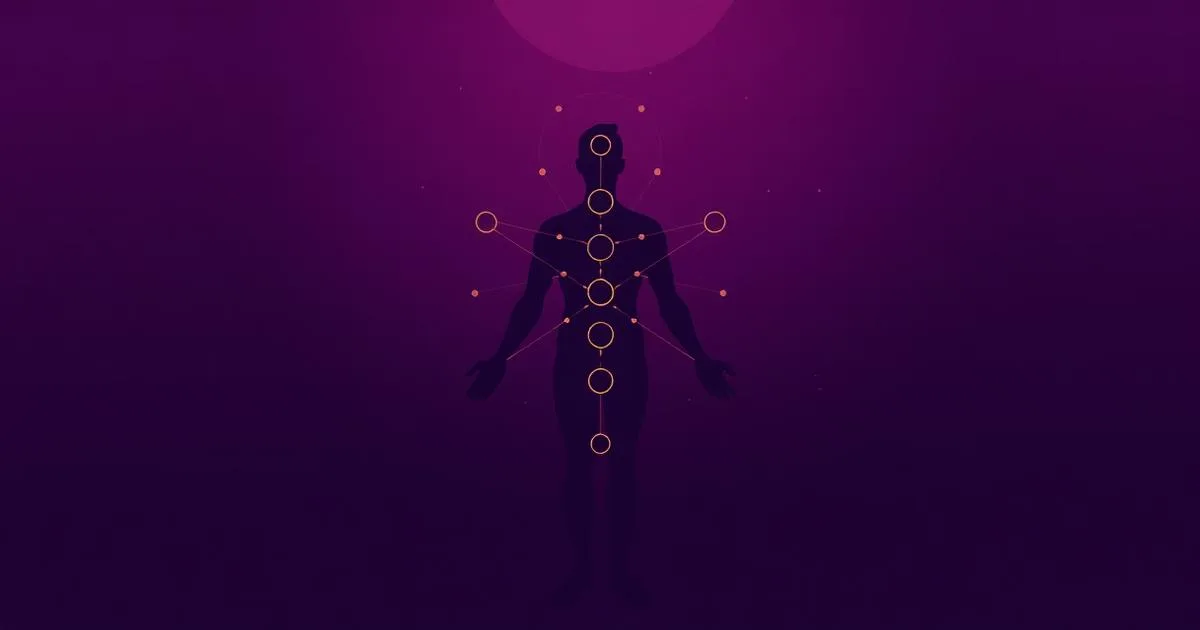
Human Design is a modern self-knowledge system that brings together astrology, the I Ching, Kabbalah and a reinterpretation of the chakras into a single chart called the bodygraph. From your date, time and place of birth, the system produces a map showing five aura types, nine energy centers, channels, gates, a personality profile, a strategy and an inner authority.
Its purpose is to offer a structured reading of how each person works energetically, to support decisions that feel more aligned and a deeper understanding of yourself. It is not an absolute truth or a diagnosis: it is a tool for observation, reflection and personal exploration.
What Human Design is
Human Design is a self-knowledge system that offers a detailed reading of a person based on their date, time and place of birth. It combines elements of Western astrology and the birth chart, the I Ching, Kabbalah and a reinterpretation of the chakra system to produce a chart called the bodygraph.
That chart works as a symbolic map of how a person functions energetically. It shows which centers are active, which channels and gates are present, the aura type, the personality profile, the recommended strategy and the inner authority for making decisions.
Origin and foundations of the system
Human Design was first made public in 1987 as a system of self-inquiry. Since then it has evolved and spread through publications, training programs and communities devoted to self-knowledge.
Its conceptual base draws on four broad traditions:
- Western astrology: planetary positions at the moment of birth
- I Ching: the 64 hexagrams as the basis for the gates of the bodygraph
- Kabbalah: the structure of the tree of life applied to the channels
- The chakra system: reinterpreted as nine energy centers
This combination produces a system of its own that belongs to no single tradition, but brings them together into a distinct framework — with a logic close to that of our unified interpretation of several disciplines.
How Human Design has evolved
1987
The founding vision of the Human Design system appears
1992
The first manual is published and the system starts spreading through self-knowledge circles
2000s
International expansion through courses, websites and charting software
2010s
Wider popularity within personal development and wellbeing
2020s
Growing presence in digital content, online readings and communities
How a Human Design chart is calculated
Three pieces of information are needed to generate a bodygraph:
- Date of birth
- Exact time of birth
- Place of birth
With those, the system calculates planetary positions at two moments: the moment of birth, and a point roughly 88 days earlier. Those two calculations produce what are known as the conscious design (personality) and the unconscious design, which are laid over each other in the same chart.
The result is a visual map showing defined and undefined centers, active channels, present gates, and the full configuration that gives rise to the type, the profile, the strategy and the inner authority.
Why the accuracy of your birth time and place matters
The place of birth matters too, because it determines the time zone and the exact geographic position used to calculate planetary positions. Together, time and place allow for a precise reading of the bodygraph.
If the exact time is unknown, the chart can still be calculated, but some elements may vary. That is worth keeping in mind when interpreting the results.
Key components of the system
The bodygraph holds several layers of information that are read together. These are the main components:
Types
Human Design sorts people into five types according to their energy configuration: Generator, Manifesting Generator, Manifestor, Projector and Reflector. Each type has a different way of interacting with the world and of making decisions.
Centers
The bodygraph includes nine energy centers, which may be defined (consistently active) or undefined (receptive to the environment). The centers represent areas such as identity, communication, emotions, intuition or life force.
Channels and gates
Channels connect two centers and represent specific capacities or dynamics. Each channel is made up of two gates, which correspond to the 64 hexagrams of the I Ching. Active gates point to qualities or themes present in the person.
Profile
The profile describes the role a person tends to play in life. It is written as a pair of numbers (3/5 or 2/4, for example) representing lines of the I Ching. Each combination suggests a particular way of learning, relating and contributing.
Strategy
The strategy is what the system recommends to each type when making decisions or starting something. A Generator's strategy is to "respond", for instance, while a Projector's is to "wait for the invitation".
Inner authority
Inner authority points to what Human Design considers the most reliable decision-making mechanism in each case. It may be sacral, emotional, splenic, ego-based, projected, environmental or lunar, depending on which centers are defined in the chart.
The five Human Design types
| Type | Main trait | General strategy |
|---|---|---|
| Generator | Sustained life force, capacity for steady work | Respond before acting |
| Manifesting Generator | Powerful energy with the ability to initiate after responding | Respond, then inform |
| Manifestor | Able to initiate and make an impact without waiting | Inform before acting |
| Projector | Strategic vision, deep reading of others | Wait for the invitation |
| Reflector | Sensitivity to the environment, mirror of the collective | Wait a full lunar cycle |
The nine centers of the bodygraph
Each center represents a functional area of the person. When a center is defined, it works consistently and predictably. When it is undefined, it is more receptive and varies with the environment.
| Center | Main theme | General reading |
|---|---|---|
| Head | Inspiration, mental pressure | Source of questions and inner curiosity |
| Ajna | Thinking, mental processing | How you analyze, conceptualize and form opinions |
| Throat | Expression, communication, action | Channel for manifesting and putting things into words |
| G / Identity | Direction, love, identity | Inner compass of purpose and meaning |
| Heart / Ego | Willpower, self-worth, materialising | Strength of commitment and self-esteem |
| Spleen | Intuition, instinct, survival | Immediate bodily alertness and wellbeing |
| Solar Plexus | Emotions, desire, sensitivity | Emotional wave and gradual clarity |
| Sacral | Life force, response, fertility | Main engine of available energy |
| Root | Pressure, drive, adrenaline | How you handle stress and urgency |
Examples of gates in the bodygraph
Gates are specific points in the bodygraph representing qualities, themes or capacities. There are 64 in total, tied to the hexagrams of the I Ching. Here are a few examples by way of orientation:
| Gate | Brief meaning |
|---|---|
| Gate 1 | Individual creativity, expression of the authentic self |
| Gate 34 | Personal power, strength and autonomy to act |
| Gate 51 | Initiation, the capacity to face the unexpected |
| Gate 57 | Subtle intuition, immediate perception of the environment |
| Gate 62 | Detail, logical organization and precise expression |
Three simplified examples of a Human Design chart
These examples are illustrative and fictional. They exist only to show how the system reasons.
Illustrative example
A chart with steady, practical energy
Type: Generator
Authority: Sacral
Profile: 3/5
Key centers: Defined Sacral, defined Throat, defined Root
Interpretation: Someone with a strong capacity for sustained work. A defined Sacral center points to steady life force when they engage with what genuinely draws a response from them. A connected Throat suggests ease in expressing and materialising.
In practice: They do best committing only to what produces a clear gut response. When they push without that response, they tend to burn out or grow frustrated.
Illustrative example
A chart with the drive to initiate
Type: Manifestor
Authority: Ego
Profile: 5/1
Key centers: Defined G center, defined Heart, defined Throat
Interpretation: A chart with a strong capacity to initiate and to make an impact. The defined G center brings a sense of direction, and the Heart connected to the Throat allows action driven by determination.
In practice: They need to inform those around them before acting, to avoid needless resistance. Their biggest challenge is learning not to push when the impulse is not genuine.
Illustrative example
A chart with emotional depth
Type: Projector
Authority: Emotional
Profile: 2/4
Key centers: Defined Spleen, defined Heart, defined Solar Plexus
Interpretation: Someone with a strong ability to read others and deep emotional sensitivity. A defined Solar Plexus means their decisions improve when they let the emotional wave pass before acting.
In practice: They benefit from waiting for genuine invitations and from not rushing in moments of emotional intensity. When they respect their wave, their decisions are clearer and more durable.
How to use Human Design in practice
The value of Human Design is not in knowing your chart, but in applying what you notice. Here are some concrete ways to work with it:
Watch your decision-making patterns
Start by noticing whether your best decisions came from responding, from impulse, from waiting or from emotional clarity. Then compare that with what your chart suggests.
Experiment with your strategy
This is not about following a rule to the letter. It is about testing whether your type's strategy matches what you observe in your own life. If you are a Generator, try responding before initiating. If you are a Projector, notice what happens when you wait for a genuine invitation.
Use the chart as a mirror, not a label
The bodygraph is more useful when you use it to ask yourself questions than when you use it to hand yourself closed answers. Treat it as a starting point for reflection, not as a final destination.
Turn what you notice into small actions
Good use of Human Design does not end with the reading. It turns into concrete adjustments: changing a habit, setting a boundary, respecting a rhythm, leaving more room for pause, or acting more decisively when the impulse is clear. Keeping a journal to record those adjustments makes them much easier to follow.
Recommendations and limits
It is not an absolute truth
Human Design is a tool for observation, not a diagnosis. Your chart describes tendencies and dynamics, not a fixed destiny or a closed identity — much like BaZi and its energy cycles.
It does not replace professional help
It should not be used as a substitute for medical, psychological, legal or financial advice. It is a complementary tool for self-knowledge.
Be careful with automated interpretations
Data quality
How reliable your chart is depends directly on the accuracy of your birth time and place. If the data is not exact, some elements of the reading may vary.
Conclusion
Human Design offers a rich, detailed framework for exploring yourself. It is not an exact science or a definitive answer, but it can be a valuable tool for observing your patterns, understanding your rhythms and making decisions with more clarity.
Used with judgment, curiosity and honesty, Human Design does not pull you away from reality. Quite the opposite: it can help you see it in more depth and act with more consistency.
Key ideas to remember
Human Design is a self-knowledge system that brings astrology, the I Ching, Kabbalah and the chakras together into a chart called the bodygraph.
Your type, strategy and inner authority are the three most practical starting points for experimenting.
An accurate birth time is essential for a reliable chart.
The bodygraph is not a label: it is a mirror that invites you to observe, not to box yourself in.
It replaces neither your own judgment nor professional help. It is a tool for reflection, not a diagnosis.
Automated interpretations can point the way, but human judgment should always have the last word.
Frequently asked questions about Human Design
What is Human Design?
Human Design is a modern self-knowledge system that brings together astrology, the I Ching, Kabbalah and a reinterpretation of the chakras into a chart called the bodygraph. It is calculated from your date, time and place of birth.
What is the bodygraph?
The bodygraph is the chart, or energy map, used in Human Design. It shows the centers, channels and gates active in a person, along with their type, profile, strategy and inner authority.
How many types are there in Human Design?
There are five: Generator, Manifesting Generator, Manifestor, Projector and Reflector. Each one has a different strategy for making decisions.
What is inner authority?
Inner authority is the mechanism that, according to Human Design, points to the most reliable way for each person to make decisions. It can be sacral, emotional, splenic, ego-based and others.
Why does the exact time of birth matter?
Because small differences in time can change the type, the authority or the active centers in the chart. A variation of minutes can alter meaningful parts of the reading.
Does Human Design replace professional help?
No. Human Design is a tool for self-knowledge and reflection. It should not be used as a substitute for medical, psychological, legal or financial advice.
Explore your chart
Bring Human Design into your path of self-knowledge
If you would like to explore your Human Design chart within a wider approach to self-knowledge, Ovinchi lets you fold it into your holistic profile and use it as a practical tool for observing yourself and deciding with more awareness.
Keep reading
Self-knowledge
How we unify BaZi, birth chart, Human Design, palmistry and graphology for a clear answer
Discover how Ovinchi combines five self-knowledge disciplines to build an integrated, coherent and easy-to-understand interpretation.
20 minSelf-knowledge
Birth chart: what it is, how it's calculated and how to use it to know yourself better
Discover what a birth chart is, how it's precisely calculated and how to interpret planets, signs, houses and aspects for better decisions.
16 minSelf-knowledge
What is BaZi: a clear guide to the Four Pillars of Destiny and how to read your chart
Discover what BaZi is, how a Four Pillars chart is built and how to interpret it with discernment for better self-knowledge.
18 minSelf-knowledge
Birth Chart, BaZi and Human Design: Why They Disagree
All three start from your date, time and place of birth yet reach different conclusions. Why they diverge, and what to do when they contradict.
8 minKeep exploring