
What BaZi Is: a clear guide to the Four Pillars of Destiny and how to read your chart
Discover what BaZi is, how a Four Pillars chart is built, and how to interpret it with good judgment to understand yourself better.
In short
BaZi, also known as the Four Pillars of Destiny or the Eight Characters, is a classical discipline of Chinese metaphysics that turns your date and time of birth into a symbolic map of time. That map is built from Heavenly Stems and Earthly Branches, and it is used to understand personality patterns, life tendencies, ways of acting, talents, challenges and rhythms of change. At Ovinchi this reading is never used alone: it is part of our unified interpretation of five disciplines.
Put simply, BaZi does not set out to tell you rigidly who you are, nor to predict your life as if everything were already written. Its value lies in offering a structured reading of how you tend to operate, which energies are strongest in you, and which dynamics can help you decide with more awareness.
Used with judgment, BaZi can be a powerful tool for self-knowledge, reflection and personal observation. It does not replace your will or your decisions. It helps you understand yourself well enough to act with more clarity.
What does BaZi mean?
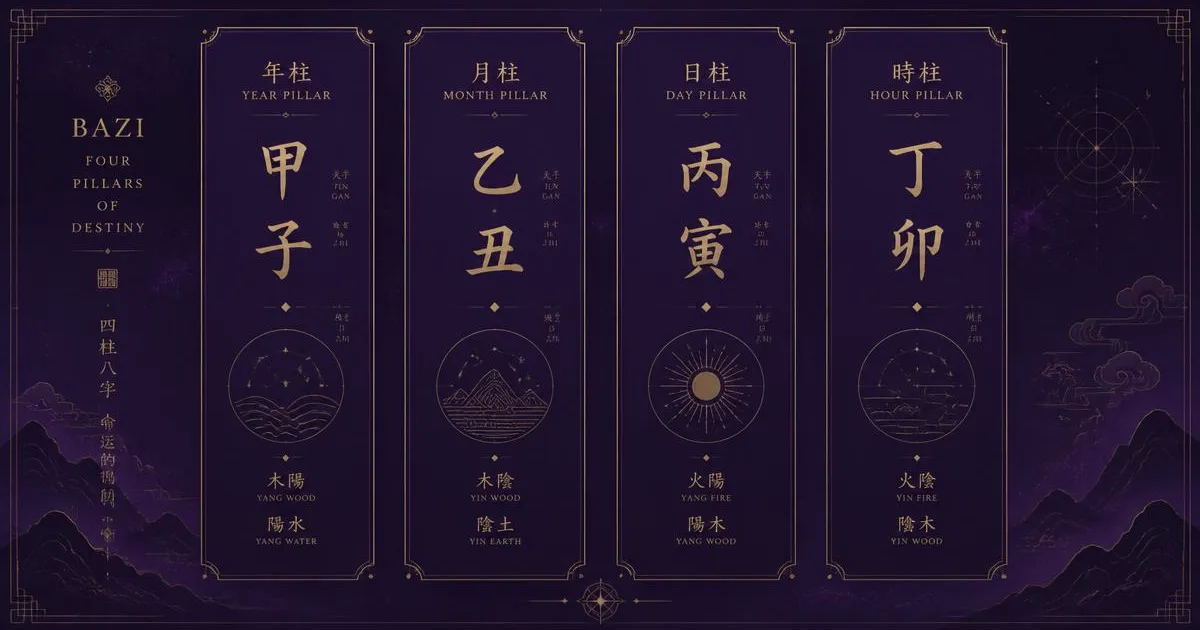
The word BaZi literally means "Eight Characters". It is called that because the chart is made up of four pillars, and each pillar holds two characters:
- a Heavenly Stem
- an Earthly Branch
The four pillars are:
- Year
- Month
- Day
- Hour
Four pillars of two characters each makes eight in total. That is where the name comes from.
Where does BaZi come from?
BaZi belongs to a very old tradition of observing time in Chinese culture. Its foundations come from the combination of two major systems:
1. The calendar and the encoding of time
Chinese tradition developed a way of recording time by combining ten Heavenly Stems and twelve Earthly Branches, producing a cycle of 60 combinations. This is known as the sexagenary cycle, and it has been a cornerstone of the traditional Chinese calendar.
2. The cosmology of yin, yang and the five elements
That calendar system did not remain a mere way of counting days. It was also integrated with a view of the world based on:
- yin and yang
- Wood, Fire, Earth, Metal and Water
In BaZi, time is read not just as a date but as an energetic quality that can be interpreted symbolically.
How the BaZi framework evolved
1400–1100 BCE
Ritual records and early dating systems in ancient China
Following centuries
The Gan-Zhi system consolidates, with Heavenly Stems and Earthly Branches
3rd century BCE
The lunisolar calendar and the solar terms are developed
Classical period
The system is used to record years, months, days and hours
Later tradition
The Four Pillars method takes shape as an interpretive system
Today
BaZi applied to self-knowledge and personal reflection
How is a BaZi chart built?
A BaZi chart is calculated from:
- the date of birth
- the time of birth
- the place of birth
- the calculation system used
Precision matters here. A difference in the time can change the hour pillar and shift some nuances of the interpretation. And here is something that catches many people out: two calculators can give you a different animal or a different element for the same date of birth. It usually does not mean one of them is broken. They apply different criteria, and it is worth knowing which.
When the BaZi year actually starts
The BaZi year does not start on 1 January. Nor does it necessarily start at Lunar New Year, which is the most common confusion.
The majority convention in BaZi uses Li Chun (立春), the start of spring. Li Chun is not a calendar date: it is an instant, the moment the Sun reaches 315° of ecliptic longitude. It falls between 3 and 5 February.
Lunar New Year, by contrast, moves between 21 January and 20 February. They are two different boundaries, so they come apart — and they do so in both directions:
| Year | Lunar New Year | Li Chun | What happens between the two dates |
|---|---|---|---|
| 1990 | 27 January | 4 February | Eight days in which the lunar calendar already says Horse while Li Chun still says Snake (1989, Ji Si — Earth Snake) |
| 2015 | 19 February | 4 February | The other way round: Li Chun is already in the Goat while the lunar calendar is still in the Horse of 2014 |
A concrete example: someone born on 30 January 1990 shows up as a Horse on many websites, and as a Snake in a BaZi chart calculated from Li Chun. Both numbers follow a defensible rule; what differs is the boundary each one uses.
There is one more detail. Because Li Chun is a global instant, the local date it falls on is not the same in every time zone: it can be 3 February in one zone and 4 February in another. So for anyone born right on the boundary, the time and place of birth are needed, not just the date.
The month follows the same logic as the year: it is determined by solar terms (jieqi), not by lunar months.
The hour pillar is not simply read off the clock
The time recorded on a birth record is clock time, and clock time is not solar time. A time zone is a political convention, not an astronomical one: the whole of China uses UTC+8 even though it spans five geographical zones.
Time zones also change over time. Korea moved from UTC+8:30 to UTC+9 in 1912, went back to UTC+8:30 in 1954, and returned to UTC+9 in 1961, with three stretches of daylight saving along the way (1948–51, 1955–60 and 1987–88). Each of those changes shifts the hour pillar of anyone born in those periods.
Which criteria Ovinchi uses
Since the criteria change the result, it makes sense to state openly which ones are applied:
- Year boundary: the real instant of Li Chun, expressed in the local time zone.
- Month: solar terms.
- Day pillar: changes at midnight. With one exception: early Zi (23:00–23:59) takes the following day's stem, and only in order to derive the hour stem.
- Time zones and daylight saving: resolved through the IANA database rather than fixed offsets, so historical changes are applied correctly.
- Hour pillar: clock time, not true solar time, following the criterion of the Joey Yap school.
That last point deserves an explanation, because there is no single correct way of doing it. Two schools coexist within BaZi. The Joey Yap school, the most widespread one, derives the hour pillar from clock time and takes into account neither geographical longitude nor true solar time. The classical school of Joseph Yu does apply them, for consistency with the astronomical basis of the system. The two are not compatible criteria: they give different results for the same person.
If you came here looking for which animal is yours, the case of people born in late January and early February is covered in more detail in our guide to the BaZi animals.
What is the Day Master in BaZi?
Of everything in the chart, one of the most important concepts is the Day Master.
The Day Master is the Heavenly Stem of the day pillar. It is treated as the central point from which the chart is interpreted, because it represents the ground from which the person expresses themselves.
The ten Heavenly Stems in BaZi
The Heavenly Stems represent the most visible expression of energy. There are ten because the five elements each appear in yin and yang polarity. That logic of elements and polarities plays a role in BaZi close to that of planets and signs in the birth chart and how it is calculated. Close, but not the same: BaZi does not look at where the planets were, which is why it does not always say what your birth chart or Human Design says.
| Stem | Name | Polarity | Element | Indicative meaning |
|---|---|---|---|---|
| 甲 | Jia | Yang | Wood | Growth, initiative, direction |
| 乙 | Yi | Yin | Wood | Flexibility, adaptation, tact |
| 丙 | Bing | Yang | Fire | Drive, visibility, enthusiasm |
| 丁 | Ding | Yin | Fire | Sensitivity, precision, inner glow |
| 戊 | Wu | Yang | Earth | Structure, stability, support |
| 己 | Ji | Yin | Earth | Care, cohesion, nourishment |
| 庚 | Geng | Yang | Metal | Decisiveness, firmness, execution |
| 辛 | Xin | Yin | Metal | Detail, refinement, discernment |
| 壬 | Ren | Yang | Water | Breadth, movement, exploration |
| 癸 | Gui | Yin | Water | Intuition, depth, observation |
The twelve Earthly Branches and their animals
The Earthly Branches are associated with the BaZi animals, their meaning and their relationships, with seasons, with the rhythms of time and with the more inward dynamics of the chart.
| Branch | Animal | Element | Indicative meaning |
|---|---|---|---|
| 子 (Zi) | Rat | Water | Strategy, circulation, beginnings |
| 丑 (Chou) | Ox | Earth | Patience, work, building |
| 寅 (Yin) | Tiger | Wood | Launch, courage, expansion |
| 卯 (Mao) | Rabbit | Wood | Bonding, diplomacy, subtlety |
| 辰 (Chen) | Dragon | Earth | Transition, breadth, change |
| 巳 (Si) | Snake | Fire | Focus, calculation, practical intuition |
| 午 (Wu) | Horse | Fire | Action, vitality, exposure |
| 未 (Wei) | Goat | Earth | Care, creativity, cohesion |
| 申 (Shen) | Monkey | Metal | Technique, versatility, execution |
| 酉 (You) | Rooster | Metal | Order, precision, discernment |
| 戌 (Xu) | Dog | Earth | Responsibility, boundaries, support |
| 亥 (Hai) | Pig | Water | Depth, integration, rest |
How is a BaZi chart interpreted?
A BaZi reading is not done by analyzing each symbol in isolation. The key is watching how they relate to one another.
Stems: the most visible layer
These tend to be associated with what a person expresses most directly: style, attitude, way of acting, presence.
Branches: the more inward layer
These are usually read as deeper layers: motivations, emotional rhythms, inner environment, or how experience is processed.
Interactions: the heart of the interpretation
This is where the following come into play:
- combinations
- transformations
- clashes
- harms
- punishments
These relationships should not be read simplistically as "good or bad". They indicate whether an energy flows easily, needs readjusting, or produces tension and movement.
Combinations and clashes in BaZi
What combinations are
Combinations show that certain energies cooperate, support each other or tend to integrate. In practical terms, they can point to a capacity for stabilising, materialising or connecting different parts of the personality.
What clashes are
Clashes show friction, change, discomfort or a need for movement. In a mature reading, a clash is not read as doom but as a signal that something needs adjusting.
Three simplified examples of a BaZi chart
These examples are illustrative. They do not correspond to real people and exist only to show how the system reasons.
Illustrative example
A chart inclined to structure
Pillars: Bing Xu · Ji Chou · Jia Zi · Ding Mao
Interpretation: The Day Master is Jia, Yang Wood. There is an energy of growth, vision and initiative, but also a clear pull towards structure and consolidation.
In practice: This is a chart that benefits greatly from routines, clear priorities and sustained habits. When this person orders their energy, they bring things into being more easily.
Illustrative example
A chart with the energy of change
Pillars: Ren Zi · Bing Wu · Ji You · Yi Mao
Interpretation: Here there are tensions between branches that suggest movement and readjustment. This person may go through phases of change, or feel that life keeps forcing them to renegotiate their plans.
In practice: Things usually go better when they do not force an artificial stability. Planning with flexibility and reviewing often suits them.
Illustrative example
A chart that tightens under pressure
Pillars: Gui Hai · Wu Shen · Geng Yin · Ding Si
Interpretation: Energies of firmness, competitiveness and reaction combine here. It can describe someone decisive, but at risk of hardening too much when under pressure.
In practice: They need to look after their environment, their rest and their boundaries. When the tension drops, their ability to execute improves considerably.
What BaZi is useful for in self-knowledge
BaZi can be particularly useful for:
Understanding personal patterns
How you respond to stress, how you tend to decide, what drives you and what drains you.
Identifying rhythms
Not everyone moves forward the same way. Some need structure, others space, others focus, others pause.
Deciding with more awareness
A well-understood reading can help you avoid pushing yourself in the wrong direction and design actions that fit you better.
Turning self-knowledge into practice
This is the most important point. The value of BaZi is not in the theory but in how it helps you live with more clarity.
What BaZi is not
It is also worth being clear about what BaZi is not.
It is not a closed verdict
Your chart neither condemns nor limits you. It describes tendencies, not a fixed and unchangeable fate.
It does not replace your own judgment
Your context, your environment, your decisions and your habits remain decisive.
It does not replace professional help
It should not be used as a substitute for medical, psychological, legal or financial advice.
It makes no sense used rigidly
When someone uses BaZi to label themselves or to justify anything at all, most of its value is lost.
How to use BaZi with judgment day to day
If you want to bring BaZi in usefully and maturely, these are good practices:
Use it to observe yourself, not to box yourself in
The chart should open questions, not close them.
Look for repeating patterns
Where you get stuck, where you flow, what kind of pressure activates you and what kind drains you.
Turn the interpretation into small actions
Good use of BaZi does not end with the reading. It turns into concrete decisions, and supporting them with journaling and an emotional diary helps you keep them:
- changing a routine
- setting a boundary
- slowing down
- ordering your priorities
- sustaining your energy better
Review it honestly
This is not about believing without thinking. It is about noticing whether what you read helps you understand yourself better and act better.
BaZi in Ovinchi: a practical way of looking inward
In Ovinchi, BaZi fits particularly well as a self-knowledge tool because it does not stop at a surface label. It lets you explore traits, rhythms and inner tensions in more depth, and turn that looking into a more conscious relationship with yourself.
Not as a magical promise. Not as a closed answer. But as a structured way of understanding yourself better and taking steps that fit who you actually are.
Conclusion
BaZi is a complex discipline, but what it is good for can be said very simply: it offers a symbolic map for understanding your tendencies, your rhythms and your ways of acting.
Used with judgment, BaZi does not pull you away from reality. Quite the opposite: it can help you see it more clearly. And that makes it a valuable tool for self-knowledge, reflection and more conscious decisions.
Frequently asked questions about BaZi
What does BaZi mean?
BaZi means "Eight Characters" and refers to the eight symbols that make up the birth chart in the Four Pillars of Destiny system: a Heavenly Stem and an Earthly Branch for each of the four pillars — year, month, day and hour.
Is BaZi the same as the Chinese horoscope?
No. The popular Chinese horoscope usually focuses on the animal of the birth year alone. BaZi reads year, month, day and hour together, which makes it far more complete: the year animal is only one of the eight characters.
What is the Day Master in BaZi?
The Day Master is the Heavenly Stem of the day pillar. It is considered one of the central points of the chart because it represents the basic nature from which the whole map is interpreted.
What is a BaZi chart for?
It is used to explore personality patterns, life tendencies, inner rhythms and ways of making decisions with more awareness. It describes how you tend to work, not what will happen to you.
Does BaZi predict the future?
Not in any rigid sense. BaZi is best understood as a symbolic map of tendencies and dynamics, not as a fixed verdict on your life.
Do I need to know my exact time of birth?
It is recommended. The time determines the hour pillar, one of the four, and it can change meaningful nuances in the interpretation. A chart can still be read without it, but with less precision.
I was born in January — which animal am I?
It depends on the criteria. The BaZi year does not start on 1 January, and the majority convention starts it at Li Chun, between 3 and 5 February. If you were born in January, your year animal is almost always the one from the previous year. Someone born on 30 January 1990, for example, is a Snake by Li Chun, not a Horse.
Why do different calculators give me different animals or elements?
For two main reasons. The first is where they put the year boundary: some use Li Chun and others Lunar New Year, which can fall up to three weeks earlier or later. The second is that the "element" of the year can be named from two different layers of the same pillar: the Heavenly Stem, or the Na Yin classification. 1990 is a Metal Horse by its Stem and an Earth Horse by its Na Yin, and neither of those is a mistake.
Explore your chart
Bring BaZi into your path of self-knowledge
If you would like to explore your BaZi chart within a wider approach to self-knowledge, Ovinchi lets you fold it into your holistic profile and use it as a practical tool for observing yourself and deciding with more awareness.
Keep reading
Self-knowledge
How we unify BaZi, birth chart, Human Design, palmistry and graphology for a clear answer
Discover how Ovinchi combines five self-knowledge disciplines to build an integrated, coherent and easy-to-understand interpretation.
20 minSelf-knowledge
BaZi animals: what they mean, how they relate and what their elements reveal
Discover what BaZi animals mean, how they relate to each other and the role of elements in this Chinese metaphysics reading.
18 minSelf-knowledge
Birth chart: what it is, how it's calculated and how to use it to know yourself better
Discover what a birth chart is, how it's precisely calculated and how to interpret planets, signs, houses and aspects for better decisions.
16 minSelf-knowledge
Birth Chart, BaZi and Human Design: Why They Disagree
All three start from your date, time and place of birth yet reach different conclusions. Why they diverge, and what to do when they contradict.
8 minKeep exploring