Your archetype

    The Alchemist

    I turn intensity into wisdom.

    The Alchemist in you

    The Alchemist in you is transformation, depth and intensity. You don't stay on the surface of what happens: you go down, move through it, and come back changed. You metabolise what's complex — what others find too dense to face — and extract wisdom from intensity. Where others see a crisis, you recognise living material. That ability to turn difficult experience into understanding is your most recognisable gift.

    Its reverse is the same gift taken too far. When intensity stops being material and becomes habit, you can cling to drama or escalate conflicts that didn't need escalating: depth becomes a place to stay rather than a path to cross. The medicine is simple and demanding at once: use intensity as conscious material, not automatic escalation. Choosing when to come down is as alchemical as going down.

    How does the Alchemist show up in each of the five disciplines?

    In your astrological chart. The Alchemist lights up above all with Pluto, the planet that carries the most weight for this archetype in the whole system. Next come the eighth and twelfth houses, the two areas of the chart that speak of what isn't on display, and the presence of Lilith or Chiron. If your chart has water and fixed signs, the signal gets stronger: the ability to hold intensity without running away.

    In your BaZi. The strongest signal is PianYin, the resource that feeds on the unconventional and learns by its own routes. It comes with the water element, the one of depth and introspection, and QiSha, associated with the pressure that forces transformation. Among the animals, the Dragon and the Snake appear.

    In your Human Design. The heaviest signal is being a Reflector, the type that needs a full lunar cycle to know what it really feels. Right behind, tied, come Lunar Authority and Emotional Authority: the two ways of deciding that consist of waiting for the wave to pass instead of deciding at the peak. Line 3 of the profile, the one that learns by trying and getting it wrong, adds to it.

    In your palmistry. Let's be precise here: hand reading does not calculate your archetype. What it does is fine-tune how it is expressed. In an Alchemist it usually adds information about the stages where that transformation was most intense and about how you live it in the body.

    In your graphology. The same goes here: your signature doesn't decide that you're an Alchemist. It adds the nuance of how much of that intensity you show outwards and how much you keep, which in this archetype tends to be the difference between transforming and being overwhelmed.

    What are the Alchemist's blind spots?

    Mistaking depth for intensity. Not everything that hurts transforms. The Alchemist can end up looking for conflict or drama because calm ground feels like too little, and confuse adrenaline with growth.

    Staying in the process. It is very good at metabolising what's difficult, and that sometimes turns into never finishing the digestion. Revisiting the same wound for years can look like inner work and be exactly the opposite.

    Dragging others to its own temperature. What for you is a normal conversation can be an escalation for someone more even-tempered. Not everyone has your tolerance for intensity, and that doesn't make them any less truthful.

    The medicine is using intensity as conscious material, not as automatic escalation.

    Which other archetypes does the Alchemist fit best with?

    Ovinchi's system points to two archetypes that balance the Alchemist: the Guardian and the Healer.

    The Guardian brings what the Alchemist lacks: ground. Where one stirs things up, the other holds them, and that combination turns transformation into something liveable instead of a permanent crisis.

    The Healer adds care to the process. The Alchemist knows how to go into the dark; the Healer knows how to come out without leaving skin behind. Together, depth stops having a cost.

    Beyond what the system calculates, there is a tension that keeps repeating with the Mediator: one believes that what isn't named rots, the other that some conversations aren't worth it. Both are right some of the time, and that's where the conflict sits.

    Frequently asked questions — Alchemist

    What is the Alchemist archetype?
    The Alchemist is the personality pattern that grows by going through difficulty instead of around it. It turns crises, losses and dark periods into learning and inner change. Its strength is the capacity to hold what's complex without fleeing from it.
    How do I know if my dominant archetype is the Alchemist?
    People usually recognise themselves in it when they need to understand what happened before they can move on, feel that the hard stages shaped them more than the easy ones, and find conversations that stay on the top layer shallow.
    What's the difference between the Alchemist and the Healer?
    Both move close to pain, but in different directions. The Healer cares for and repairs, aiming to restore balance. The Alchemist goes through and transforms: it doesn't want things back the way they were, it wants them to become something else.
    Which signals activate the Alchemist in Ovinchi's calculation?
    Pluto and the eighth and twelfth houses in the astrological chart; PianYin, the water element and QiSha in BaZi; and the Reflector type together with Lunar or Emotional Authority in Human Design.

    This is an approximation. Your Holistic Self is something else.

    Eight questions give you a snapshot. Your Holistic Self is calculated by cross-referencing your five charts — birth chart, BaZi, Human Design, palmistry and graphology — turning them into a map of who you are that doesn't depend on how you feel today.

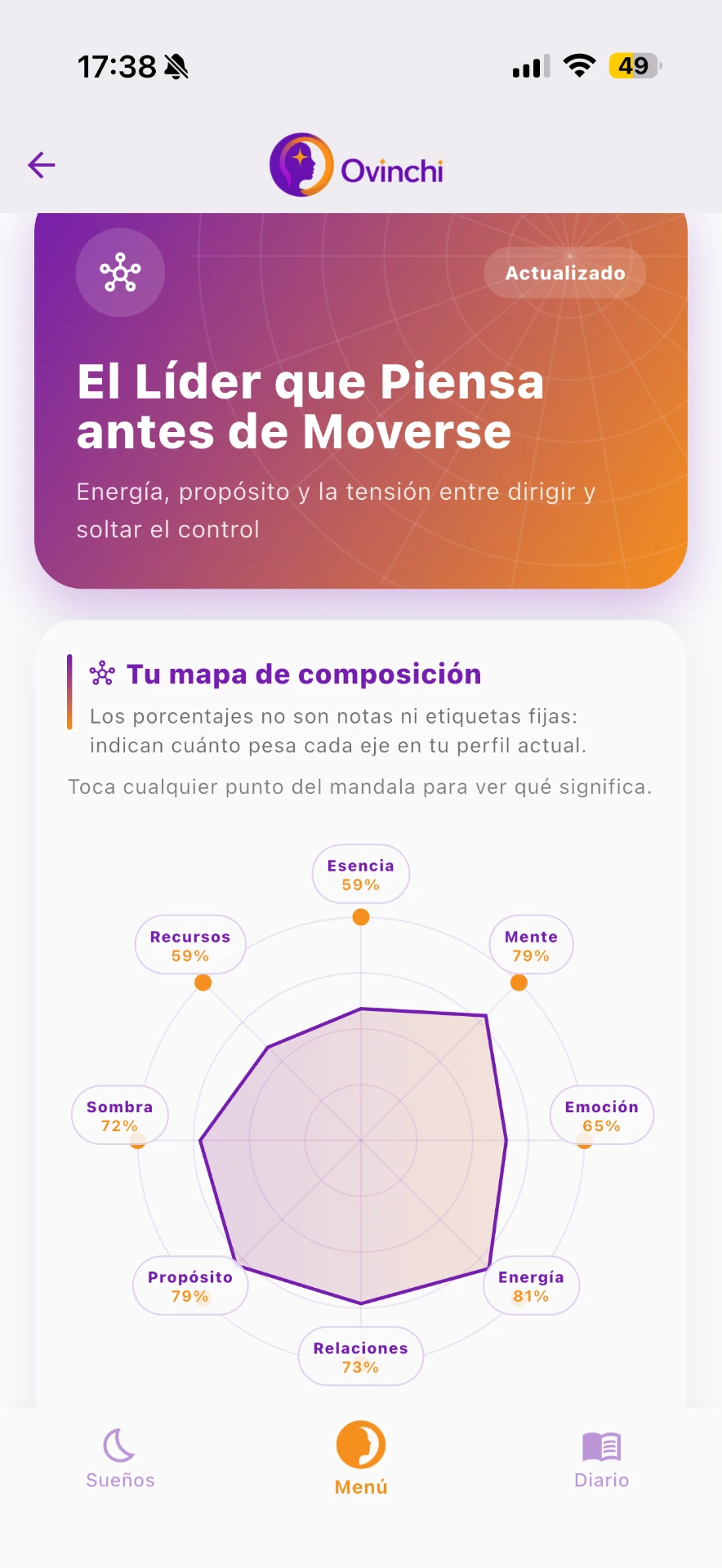
    Eight axes, not a label

    • Essencewho you are underneath it all
    • Mindhow you think and decide
    • Emotionhow you feel and regulate yourself
    • Energyhow your force moves
    • Relationshipshow you bond
    • Purposewhere you push toward
    • Shadowwhat you repeat without seeing it
    • Medicinewhat brings you back to balance
    • All twelve archetypes with their exact proportion in you, not just the strongest one
    • Your personal shadow and medicine, calculated, not generic
    • A complete PDF report to keep or share
    My Holistic Self screen in the Ovinchi app: the twelve archetypes with their proportion and the eight personal axes

    You already know your dominant archetype. What's missing is knowing in what proportion the other eleven make you up.