
Your archetype

    The Explorer

    I learn by trying things, in real life.

    The Explorer in you

    The Explorer in you is freedom, curiosity and direct experience. You don't trust the map until you've walked the terrain: you learn by trying it in real life, with your body inside the situation. You expand horizons, yours and the people close to you, because you come back with information no one else had. Your curiosity isn't aimless scattering — it's a way of knowing that needs movement to work.

    Its reverse is the same gift taken too far. When openness becomes reflex, you can avoid commitment or mistake freedom for escape: leaving before something gets heavy, changing course right when it started asking for depth. The open door stops being an option and becomes a condition. The medicine is giving freedom direction and choosing commitments that support your growth: staying can also expand horizons.
    How does the Explorer show up in each of the five disciplines?

    In your birth chart. The Explorer's strongest signal is Uranus, the planet of the unexpected and of breaking with what's established. Behind it comes Jupiter, the planet of expansion and of the search for meaning. Then the mutable signs, the air element and the ninth and fifth houses add up — the long journey and the experience sought for its own sake. Sagittarius is its sign.

    In your BaZi. Two signals tied at the top: the wood element, the one of growth and outward expansion, and PianCai, indirect wealth, the kind that arrives through unplanned routes. Among the animals the Tiger appears, and ShangGuan and JieCai add up.

    In your Human Design. It's one of the archetypes with the fewest signals in this discipline, and that says something. It's activated above all by the Manifesting Generator type and by line 3 of the profile, the one that learns by trying and discarding. The Root centre adds up after that. That it can be detected with so few signals suggests the Explorer isn't a specific type of energy, but a way of using it: moving.

    In your palmistry. It doesn't calculate the archetype. In an Explorer it usually adds information about the changes of direction in your life and about which stages you left and which ones you stayed for.

    In your graphology. Your signature doesn't decide that you're an Explorer. It adds the nuance of how much consistency lies behind the movement, which is what separates exploring from simply leaving.

    What are the Explorer's blind spots?

    Avoiding commitment. It's its shadow exactly as the system names it. Keeping every door open feels like freedom, but it's often the most elegant way of choosing none of them.

    Mistaking freedom for escape. When something gets hard, leaving and calling it "looking for new horizons" is a move the Explorer has mastered. The difference between the two usually only shows up in hindsight.

    Starting a lot and finishing little. Curiosity is its engine and also its escape hatch. There are projects of theirs that were good and that nobody ever got to see.

    The medicine is giving direction to freedom and choosing commitments that sustain your growth.

    Which other archetypes does the Explorer fit best with?

    Ovinchi's system points to two that balance it: the Architect and the Guardian.

    There's something curious here: the two that balance it are also the two it clashes with most. The Architect asks it for a plan and the Guardian asks it for roots, and both make it uncomfortable exactly to the degree that it needs them. That discomfort is the sign the combination works.

    The Architect turns into a project what the Explorer had only discovered. The Guardian gives it a place to come back to, which is what turns leaving into travelling rather than fleeing.

    Beyond what the system calculates, the most frequent friction is with the Alchemist: one turns the page looking for the next thing, the other stays digging in the same place until it understands it.

    Frequently asked questions — Explorer

    What is the Explorer archetype?
    The Explorer is the personality pattern that learns by moving. It tries new paths, widens horizons and needs direct experience to believe things. Its strength is that it opens doors others hadn't even seen.
    How do I know if my dominant archetype is the Explorer?
    It's usually recognised by whoever gets restless when everything has stayed the same for too long, learns faster by doing than by reading, and has changed direction more times than is considered reasonable without regretting any of them.
    How is the Explorer different from the Visionary?
    The Visionary sees the path before walking it; the Explorer discovers it by walking. One imagines where you could go, the other finds out what's there. They often travel together, but they're not the same.
    Which signals activate the Explorer in Ovinchi's calculation?
    Uranus and Jupiter in the birth chart, with Sagittarius and the ninth and fifth houses; the wood element and PianCai in BaZi; and the Manifesting Generator type along with line 3 of the profile in Human Design.

    This is an approximation. Your Holistic Self is something else.

    Eight questions give you a snapshot. Your Holistic Self is calculated by cross-referencing your five charts — birth chart, BaZi, Human Design, palmistry and graphology — turning them into a map of who you are that doesn't depend on how you feel today.

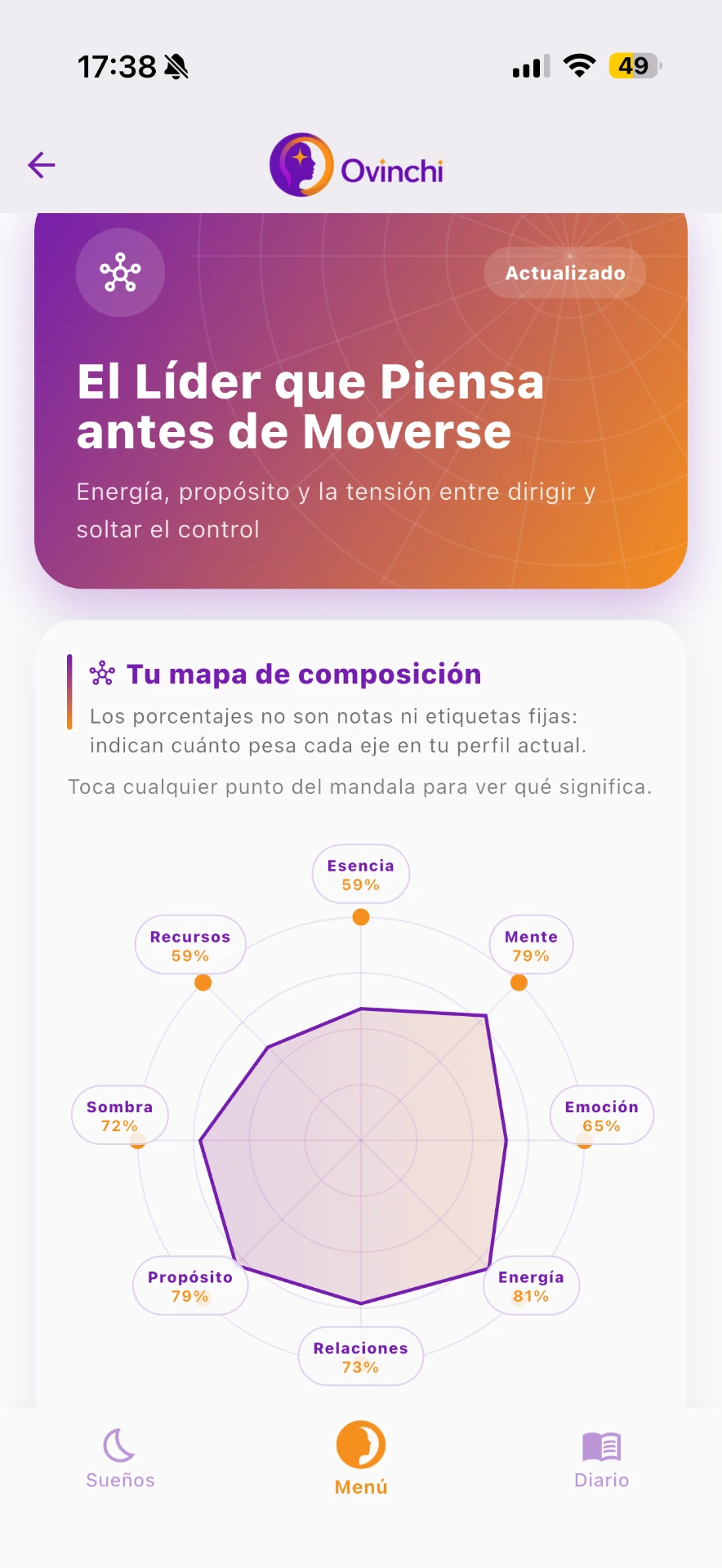
    Eight axes, not a label

    • Essencewho you are underneath it all
    • Mindhow you think and decide
    • Emotionhow you feel and regulate yourself
    • Energyhow your force moves
    • Relationshipshow you bond
    • Purposewhere you push toward
    • Shadowwhat you repeat without seeing it
    • Medicinewhat brings you back to balance
    • All twelve archetypes with their exact proportion in you, not just the strongest one
    • Your personal shadow and medicine, calculated, not generic
    • A complete PDF report to keep or share
    My Holistic Self screen in the Ovinchi app: the twelve archetypes with their proportion and the eight personal axes

    You already know your dominant archetype. What's missing is knowing in what proportion the other eleven make you up.