
Your archetype

    The Architect

    I turn vision into a plan that holds.

    The Architect in you

    The Architect in you is structure, strategy and construction. You see how the pieces fit before you move them, and you know what needs to be in place for the rest to hold. You build stable forms: systems, routines, agreements, projects that keep working once the initial excitement fades. Above all, you turn vision into plan. What stays a nice idea in other hands becomes, in yours, a sequence of steps someone can actually follow.

    Its reverse is the same gift taken too far. When structure stops being support and becomes the goal itself, you can over-control or cling to the plan even after reality has already shifted shape. Order starts defending itself. The medicine is keeping structure flexible so it serves life instead of limiting it: a plan you can revise is still a plan, usually a better one.
    How does the Architect show up in each of the five disciplines?

    In your astrological chart. The Architect is, above all, Saturn: the planet of time, limits and what is built to last. Next comes the earth element and, after that, the sixth and tenth houses, those of work and position. Virgo and Capricorn are the two signs that activate it, and a marked Midheaven reinforces the signal.

    In your BaZi. The strongest signal is ZhengCai, the wealth that is built slowly and methodically. Behind it, tied, come the earth and metal elements — one gives stability, the other precision — and ZhengGuan, which is structure and responsibility taken on. Among the animals, the Ox and the Rooster appear.

    In your Human Design. There is no dominant signal here, but four that weigh the same: a defined Ajna, which means having a consistent way of thinking; Ego Authority, which decides from what it genuinely wants to sustain; and lines 1 and 5 of the profile, the one that investigates before moving and the one that ends up solving things for others. The Root centre adds afterwards, giving the ability to take pressure without falling apart.

    In your palmistry. It doesn't calculate the archetype, but it adds a lot of nuance in this profile: it brings information about how you carry discipline day to day and at which moments structure held you up or squeezed you too tightly.

    In your graphology. It adds the detail of how much control you apply to your own expression. In an Architect it's usually the most direct indicator of whether the structure is at the service of life or the other way round.

    What are the Architect's blind spots?

    Mistaking the plan for the goal. This is the shadow that Ovinchi's system calls, literally, control. After investing so much in building the plan, changing it feels like failing, even when reality has already moved on.

    Hardening without noticing. What started as a useful structure can become a comfortable cage. The Architect rarely notices the moment it stopped choosing and started complying.

    Measuring others by its own yardstick. Not everyone needs the same level of order to function. Mistaking a different rhythm for a lack of commitment is an expensive error in personal life.

    The medicine is keeping the structure flexible enough that it serves life instead of limiting it.

    Which other archetypes does the Architect fit best with?

    Ovinchi's system points to two that balance it: the Explorer and the Creator.

    The Explorer is the exact antidote: it forces you off the plan and proves that you also get there outside it. It's uncomfortable and it's precisely what's needed.

    The Creator brings what structure doesn't generate on its own: a reason. The Architect knows how to build anything; the Creator knows what is worth building.

    Beyond what the system calculates, the tension that repeats most is with the Alchemist: one wants things to hold, the other needs them to transform. When they truly collaborate, something solid and alive comes out, and until they manage it they drive each other up the wall.

    Frequently asked questions — Architect

    What is the Architect archetype?
    The Architect is the personality pattern that turns ideas into something that holds. It thinks in steps, resources and deadlines, builds systems that last and turns intention into structure. Its strength is that what it starts tends to get finished.
    How do I know if my dominant archetype is the Architect?
    It's usually recognised by whoever needs to understand the whole plan before taking the first step, feels uneasy with permanent improvisation, and is the person everyone else eventually asks to organise things.
    What's the difference between the Architect and the Leader?
    The Architect builds the system; the Leader moves people inside it. One makes sure things work, the other makes sure someone does them. They can coexist in the same person, but they are different capacities.
    Which signals activate the Architect in Ovinchi's calculation?
    Saturn, Virgo and Capricorn in the astrological chart, along with the earth element; ZhengCai and the earth and metal elements in BaZi; and a defined Ajna, Ego Authority and lines 1 and 5 of the profile in Human Design.

    This is an approximation. Your Holistic Self is something else.

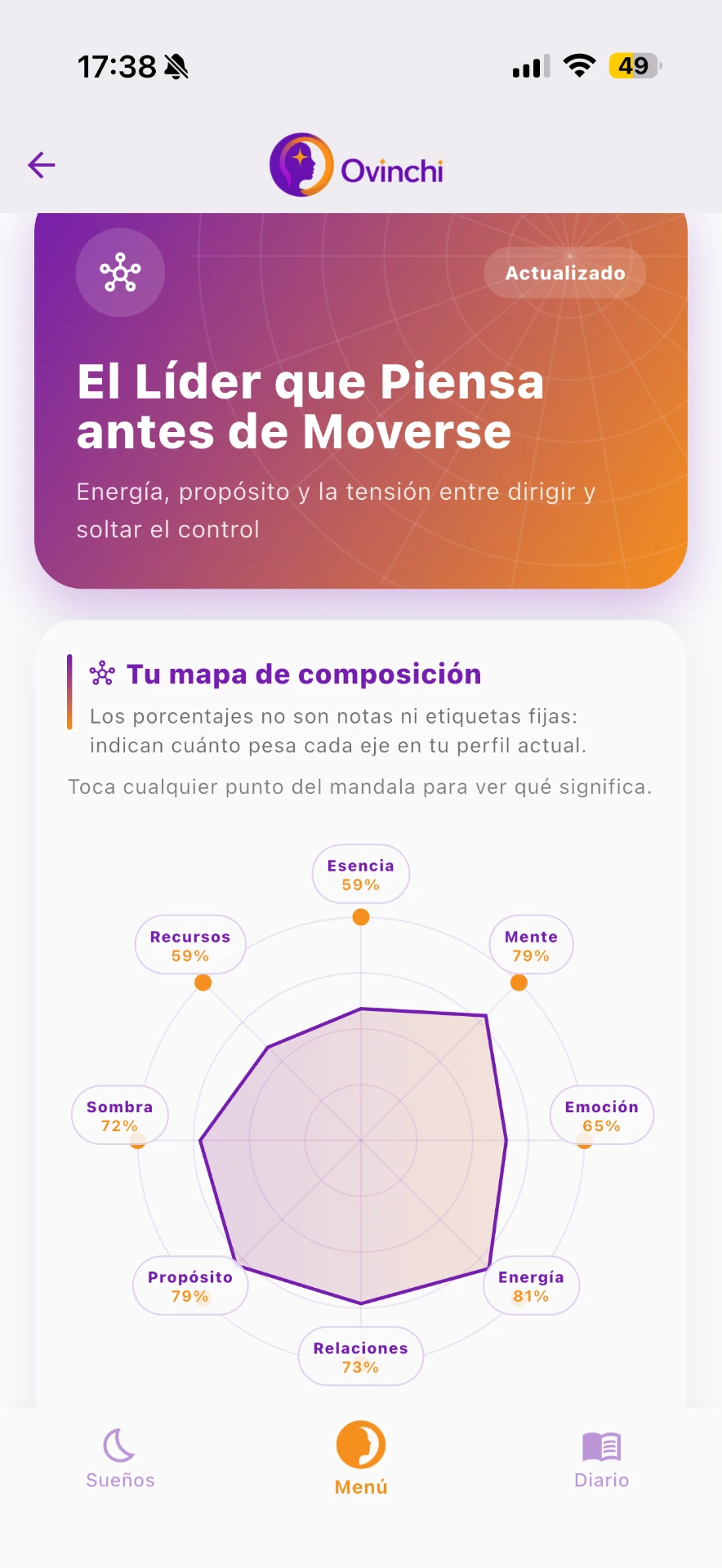
    Eight questions give you a snapshot. Your Holistic Self is calculated by cross-referencing your five charts — birth chart, BaZi, Human Design, palmistry and graphology — turning them into a map of who you are that doesn't depend on how you feel today.

    Eight axes, not a label

    • Essencewho you are underneath it all
    • Mindhow you think and decide
    • Emotionhow you feel and regulate yourself
    • Energyhow your force moves
    • Relationshipshow you bond
    • Purposewhere you push toward
    • Shadowwhat you repeat without seeing it
    • Medicinewhat brings you back to balance
    • All twelve archetypes with their exact proportion in you, not just the strongest one
    • Your personal shadow and medicine, calculated, not generic
    • A complete PDF report to keep or share
    My Holistic Self screen in the Ovinchi app: the twelve archetypes with their proportion and the eight personal axes

    You already know your dominant archetype. What's missing is knowing in what proportion the other eleven make you up.