
Your archetype

    The Communicator

    I connect ideas and people with a clear voice.

    The Communicator in you

    The Communicator in you is expression, language and connection. You find the missing word, and with it, something scattered falls into place. You connect ideas and people with clarity and voice: you translate between worlds that didn't understand each other, name what others only sensed, and move a conversation forward instead of letting it circle. Your gift isn't talking a lot — it's making what's said land and become usable.

    Its reverse is the same gift taken too far. When ease of speech runs ahead of the process of feeling, you can create noise or speak without inner alignment: sound convincing on the outside while disconnected within. Words multiply and carry less weight. The medicine is making your word precise, embodied and purposeful: say less, say it from the body and from what you truly stand for. That's where your voice regains its weight.
    How does the Communicator show up in each of the five disciplines?

    In your astrological chart. The Communicator is Mercury, the planet of the word and of thought that needs to come out. Very close behind are the air element and the third house, the one of everyday, close-range language. The eleventh house, the one of groups, adds up next, along with Gemini as a sign, the mutable signs and a marked Descendant.

    In your BaZi. It is activated, in a tie, by ShiShen and ShangGuan: the expression that flows effortlessly and the one that questions what's established and doesn't keep quiet about what it sees. Among the animals, the Rooster and the Monkey appear, both associated with mental agility, and to a lesser degree the Rat.

    In your Human Design. This is where its heaviest signal lives, tied with Mercury as the strongest in the whole archetype: a defined Throat, which is the centre of expression and manifestation. Then come Self-Projected Authority, which is knowing what you want by hearing yourself speak, and line 4 of the profile, the one of the trusted network. The strategy of informing before acting adds to it too.

    In your palmistry. It doesn't decide the archetype. In this profile it usually brings information about how your way of relating took shape and at which stages the word was your main resource.

    In your graphology. This is the discipline that adds the most nuance to this archetype, because your signature is literally expression. It brings out the difference between communicating outwards and communicating from within, which is exactly the axis where the Communicator's balance is at stake.

    What are the Communicator's blind spots?

    Creating noise. The system calls it that, plainly. When ease of speech separates from having something to say, you get many words and little signal.

    Over-explaining. Explaining too much is usually a way of asking permission. The Communicator can end up justifying decisions that didn't need justifying, and in the process weakens them.

    Speaking before knowing what it feels. This is the subtlest blind spot in this profile: the word comes out so fast that it sometimes runs ahead of the conclusion. And once it's been said out loud, it's very hard to revise.

    The medicine is making your word precise, embodied and purposeful.

    Which other archetypes does the Communicator fit best with?

    Ovinchi's system points to two that balance it: the Sage and the Mediator.

    The Sage brings the weight that fluency lacks: understanding before formulating. A Communicator with a Sage behind them doesn't speak less, they speak better.

    The Mediator adds listening. Where the Communicator connects ideas, the Mediator connects people, and that combination turns ease with words into a real capacity for understanding.

    Beyond what the system calculates, the most common friction is with the Guardian. For the Communicator, what isn't said festers; for the Guardian, some things are protected precisely by not saying them. It's an honest argument between two legitimate ways of caring.

    Frequently asked questions — Communicator

    What is the Communicator archetype?
    The Communicator is the personality pattern that understands the world by putting it into words. It connects ideas and people, translates what others don't know how to say, and needs to express in order to finish thinking. Its main tool is language.
    How do I know if my dominant archetype is the Communicator?
    It's usually recognised by whoever sorts their ideas out by saying them aloud, ends up being the bridge between people who don't understand each other, and feels physically uncomfortable when something important goes unsaid.
    What's the difference between the Communicator and the Creator?
    They share signals in BaZi, since both are activated by ShiShen and ShangGuan. The difference is where that expression is aimed: the Communicator expresses to connect with others, the Creator to give shape to something of their own. One seeks understanding, the other seeks a work.
    Does being a Communicator mean being extroverted?
    Not necessarily. It isn't about how much you talk, but about the word being your main tool for thinking and bonding. There are Communicators who write far more than they speak.

    This is an approximation. Your Holistic Self is something else.

    Eight questions give you a snapshot. Your Holistic Self is calculated by cross-referencing your five charts — birth chart, BaZi, Human Design, palmistry and graphology — turning them into a map of who you are that doesn't depend on how you feel today.

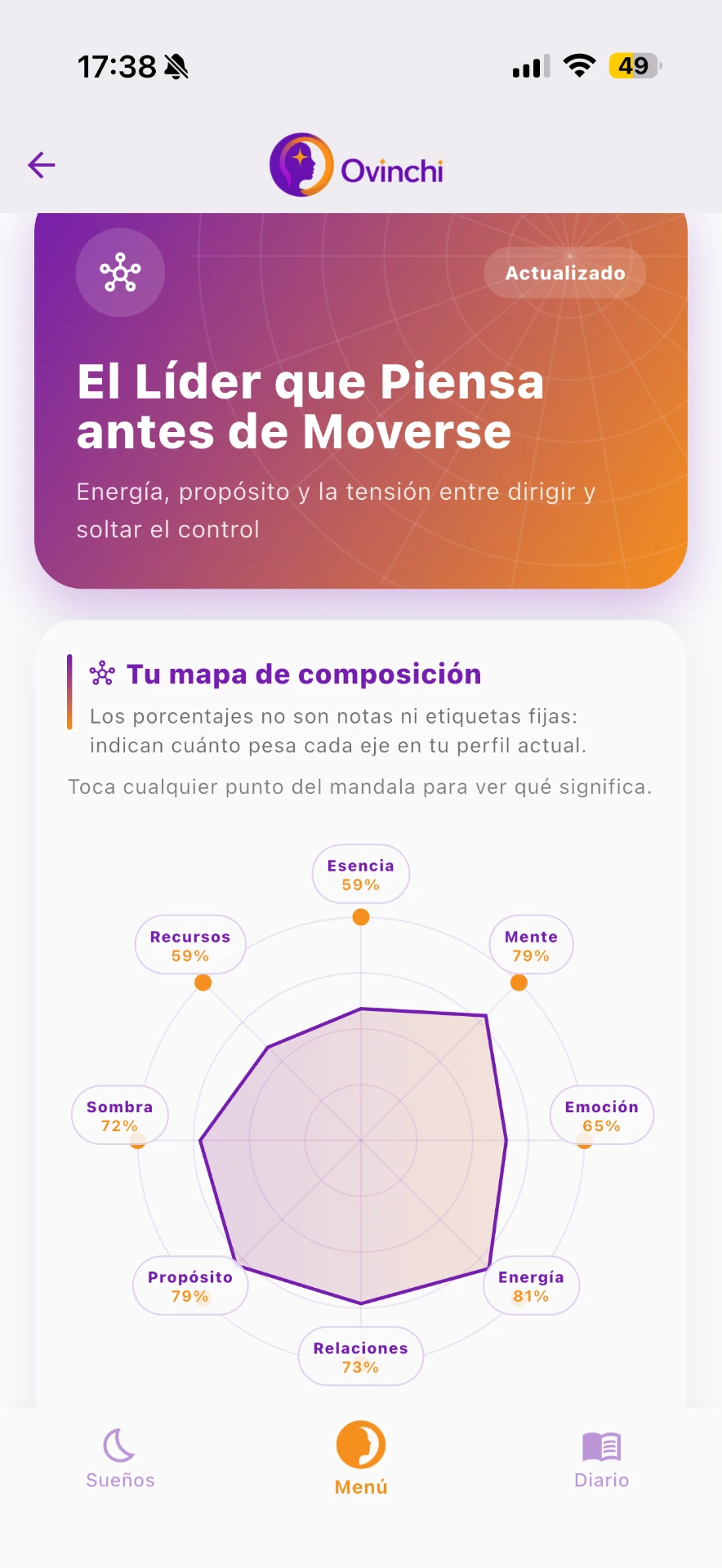
    Eight axes, not a label

    • Essencewho you are underneath it all
    • Mindhow you think and decide
    • Emotionhow you feel and regulate yourself
    • Energyhow your force moves
    • Relationshipshow you bond
    • Purposewhere you push toward
    • Shadowwhat you repeat without seeing it
    • Medicinewhat brings you back to balance
    • All twelve archetypes with their exact proportion in you, not just the strongest one
    • Your personal shadow and medicine, calculated, not generic
    • A complete PDF report to keep or share
    My Holistic Self screen in the Ovinchi app: the twelve archetypes with their proportion and the eight personal axes

    You already know your dominant archetype. What's missing is knowing in what proportion the other eleven make you up.