
Your archetype

    The Sage

    I seek to understand before I opine.

    The Sage in you

    The Sage in you is wisdom, study and discernment. You don't settle for the first explanation: you want to truly understand how something works, and that's why you bring perspective, clarity and deep understanding while others are still reacting. You know how to tell what matters from the noise and place a matter in its context. When you speak after having thought it through, what you say puts the whole conversation in order.

    Its reverse is the same gift taken too far. When understanding becomes a hideout, you can isolate yourself or over-intellectualise: analysing life from a step back, feeling like you understand it while it passes you by. The distance that gives clarity can also give cold. The medicine is keeping wisdom connected to the body, to relationship and to practice: what you understand becomes real when you live it with others.
    How does the Sage show up in each of the five disciplines?

    In your birth chart. The Sage shares a quirk with the Creator: they are the only two archetypes that no zodiac sign activates directly. It assembles itself by combination. Mercury, the air element and the ninth house — that of knowledge and the search for meaning — all weigh the same. Then the North Node, Jupiter, the mutable signs and the third house add up.

    In your BaZi. Here there is a clear, strong signal: ZhengYin, the direct resource, learning received from a reliable source. Right behind it, PianYin, knowledge sought through unconventional paths. That both forms of resource weigh so much is telling: the Sage is, literally, the archetype of whatever feeds the mind. Then come the water and metal elements.

    In your Human Design. Its strongest signal is being a Projector, the type that sees the system from outside and needs an invitation to step in. Behind it, tied, come the absence of inner authority — deciding by talking with others and taking time — a defined Ajna and line 1 of the profile, the one that needs solid foundations before moving.

    In your palmistry. It doesn't calculate the archetype. In a Sage it usually adds information about how your way of understanding has been built and in which stages study was a refuge or a tool.

    In your graphology. Your signature doesn't decide that you're a Sage. It adds the nuance of how much of what you understand actually makes it outwards, which in this profile is the difference between offering perspective and keeping it to yourself.

    What are the Sage's blind spots?

    Isolating itself. Understanding requires distance, and distance becomes comfortable. The Sage can end up watching life instead of being in it, and calling that clarity.

    Over-intellectualising. Understanding why something is happening to you isn't the same as going through it. This archetype can turn an emotion into an analysis and believe it has already dealt with it.

    Waiting too long for the invitation. The Sage rarely imposes itself, and sometimes that means its judgement never reaches where it was needed. Not speaking is also a decision, and it has consequences.

    The medicine is keeping wisdom connected to the body, to relationships and to practice.

    Which other archetypes does the Sage fit best with?

    Ovinchi's system points to two that balance it: the Creator and the Communicator.

    The Creator forces you to make something. Where the Sage analyses indefinitely, the Creator produces something imperfect and learns from it, which usually turns out to be the shorter route.

    The Communicator takes the understanding outside. A Sage who doesn't communicate stays a closed archive; with the Communicator in front, its judgement reaches whoever needs it.

    Beyond what the system calculates, the most common friction is with the Warrior: one wants to understand before acting and the other acts in order to understand. Both work, but rarely at the same time.

    Frequently asked questions — Sage

    What is the Sage archetype?
    The Sage is the personality pattern that seeks to understand before acting. It observes with perspective, draws meaning out of what happens and makes decisions from clarity. Its strength is seeing the pattern where others see scattered facts.
    How do I know if my dominant archetype is the Sage?
    It's usually recognised by whoever needs to understand the why before getting involved, is the one others ask for an opinion when things get complicated, and would rather stay quiet than say something they haven't thought through enough.
    How is the Sage different from the Communicator?
    The Sage understands, the Communicator transmits. One needs silence to reach the conclusion, the other needs to talk to get there. That's why the system names them as complementary: together, the insight actually reaches someone.
    Why does no zodiac sign activate the Sage?
    Because in Ovinchi's system it is an archetype of combination: it lights up through the sum of Mercury, the air element and the ninth house, not by inheritance from a sign. Along with the Creator, it is one of only two that work this way.

    This is an approximation. Your Holistic Self is something else.

    Eight questions give you a snapshot. Your Holistic Self is calculated by cross-referencing your five charts — birth chart, BaZi, Human Design, palmistry and graphology — turning them into a map of who you are that doesn't depend on how you feel today.

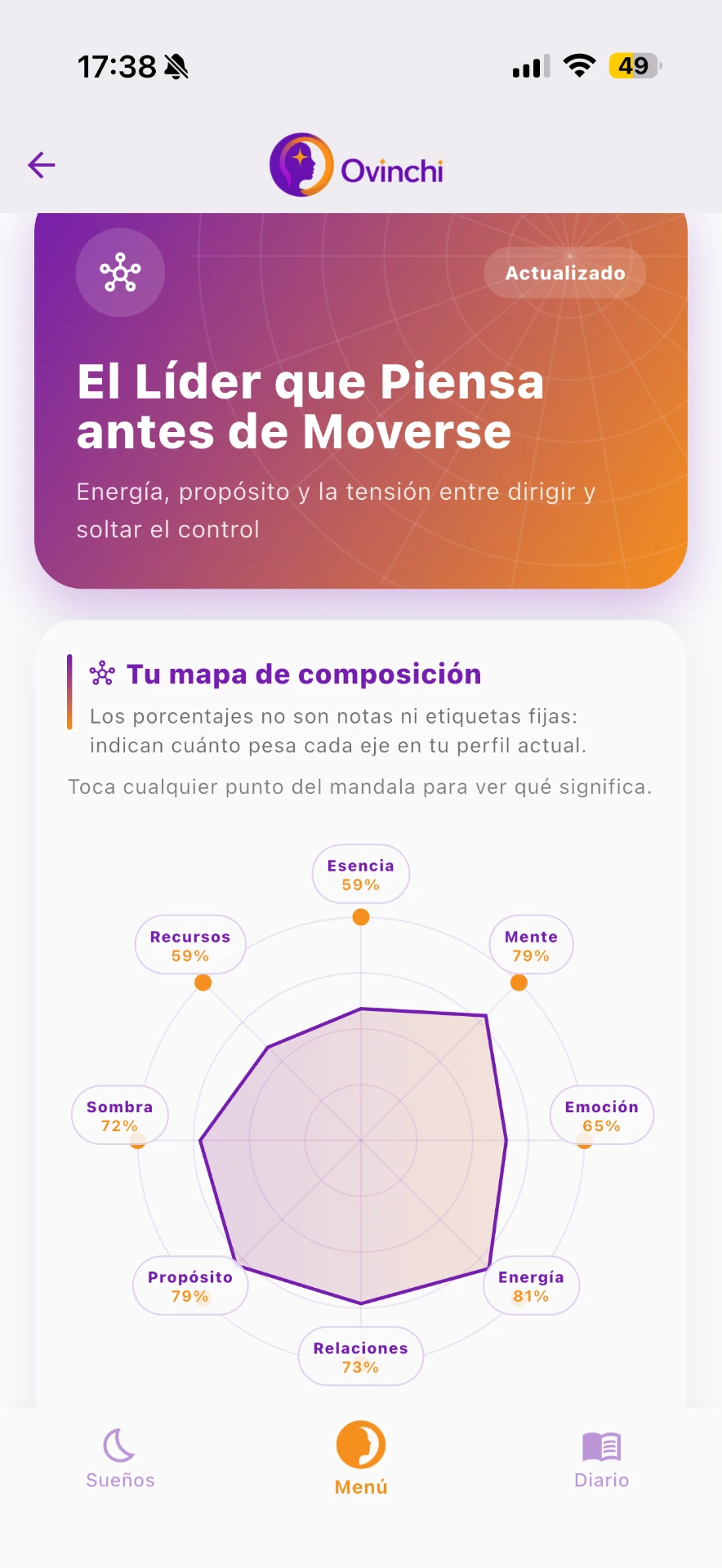
    Eight axes, not a label

    • Essencewho you are underneath it all
    • Mindhow you think and decide
    • Emotionhow you feel and regulate yourself
    • Energyhow your force moves
    • Relationshipshow you bond
    • Purposewhere you push toward
    • Shadowwhat you repeat without seeing it
    • Medicinewhat brings you back to balance
    • All twelve archetypes with their exact proportion in you, not just the strongest one
    • Your personal shadow and medicine, calculated, not generic
    • A complete PDF report to keep or share
    My Holistic Self screen in the Ovinchi app: the twelve archetypes with their proportion and the eight personal axes

    You already know your dominant archetype. What's missing is knowing in what proportion the other eleven make you up.